Health & Science
Planck's Forgotten Rule: Why Your Brain Runs on "Packets" — And Perimenopause Is Quietly Emptying the Most Important One
A 1900s physics discovery about how energy actually moves may explain the one midlife symptom women are told to just live with: the fog that flips on like a switch.
BY DIANE R. - ENERGY SYSTEM RESTORATION CO-FOUNDER · 3 MIN READ

If you're a woman in your 40s or 50s, you've probably had this exact moment.
You're mid-sentence. The word you need — an ordinary word, one you've used ten thousand times — simply isn't there. You reach for it and touch nothing. You laugh it off. You blame your age, your sleep, your third coffee. And then, a beat later, it comes back, and you wonder what just happened to the sharp, quick version of you that used to run the whole room.
Here's the part nobody tells you: that on/off quality isn't your imagination. It's the most important clue you have.
Because your brain fog didn't arrive on a dimmer switch. It didn't fade in gradually like gray hair. It feels binary — I used to be sharp, now I'm not — and that specific, all-or-nothing quality points to something most doctors never mention.
It points to a rule a German physicist discovered more than a century ago.
The rule that broke physics — and quietly explains your afternoons
In 1900, Max Planck was trying to solve a problem that had nothing to do with menopause, or brains, or women in midlife. He was studying how objects give off energy as heat. And the numbers refused to behave.
Everyone assumed energy flowed — smooth, continuous, like water from a tap. But the math only worked when Planck accepted something almost absurd: energy doesn't flow. It arrives in packets. Discrete, whole units. You either have a full packet or you don't. There is no "half a packet."
It sounded like a technicality. It won him a Nobel Prize and launched all of quantum physics.
And it turns out your cells obey the exact same rule.
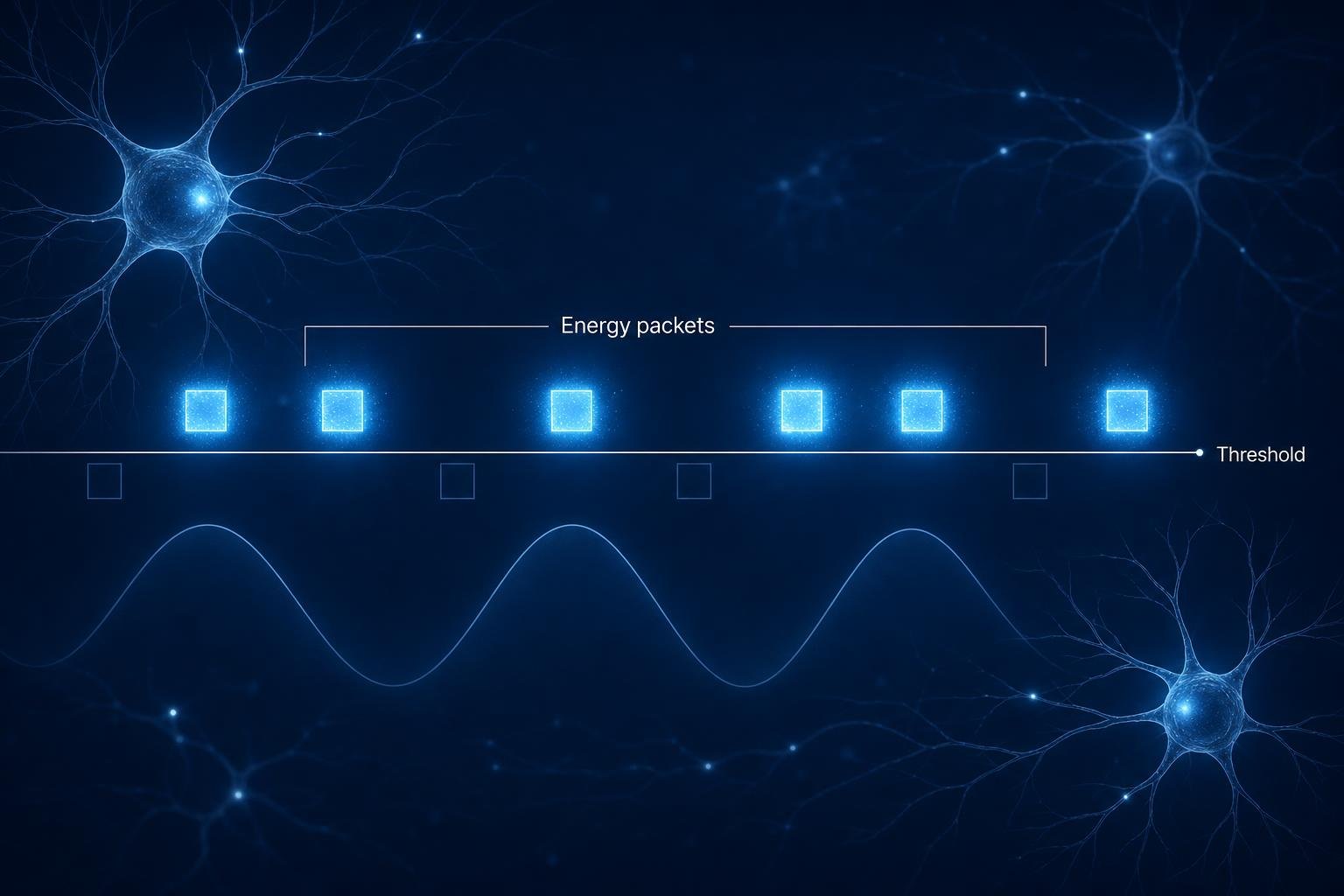
Your neurons can't "sort of" fire
A brain cell is not a dimmer. It's a switch.
To fire, a neuron has to hit a threshold — a specific energy level. Reach it, and the cell fires cleanly. Fall a hair short, and nothing happens. There is no dim, half-hearted, in-between fire. Just like Planck's packets: above the line, or below it.
And the fuel that gets your neurons over that line, fast, is a molecule called phosphocreatine.
Phosphocreatine is your cells' instant-energy reserve — the packet they draw on to fire above threshold, moment to moment, all day long. Your brain is only about 2% of your body weight but burns roughly 20% of your energy. It is the single most fuel-hungry thing you own. Which means it's also the first place to show it when the packets start running low.
When your phosphocreatine reserve is full, millions of neurons clear the threshold and fire on cue. You're sharp. Words arrive. The afternoon doesn't flatten you.
When that reserve drops — even a little — millions of those same neurons slip below the line. They don't fire slower. They just don't fire. And you feel it as fog that switches on, a word that vanishes, a 3pm wall you hit like it's physical.
So here's the real question. Why would a healthy woman's phosphocreatine reserve suddenly start running low in her 40s?
The answer is the part that should have been front-page news.
The estrogen connection nobody explained to you
Your body makes its own creatine. It runs on two enzymes with clunky names — AGAT and creatine kinase — one that builds creatine and one that puts it to work.
Both of those enzymes are regulated by your sex hormones.
Read that again, because it's the whole story. As estrogen declines through perimenopause and menopause, the machinery that keeps your creatine reserve topped up slows down. The packets stop getting refilled at the rate they used to. And women already run lower creatine reserves than men to begin with — so you started this race a step behind.
This is why the fog, the flatness, and the "I don't recognize myself" feeling so often arrive the same year. It looks like several separate symptoms. It's really one shortage, showing up in the organ that burns the most fuel first.
It was never your discipline. It was never that you stopped trying. You can't will an empty tank to drive.
Why everything you've already tried didn't fix it
Once you see the fuel gap, every dead end you've hit suddenly makes sense:
- Coffee and "push through it" borrow energy you don't have and bill you for it at 3pm. They never refill the reserve.
- Protein and collagen deliver building materials, not fuel. You can stock the whole kitchen — but if there's no gas to the stove, dinner still doesn't cook.
- More sleep and cleaner eating help around the edges, but they can't manufacture a packet your own enzymes have slowed down on making.
- Willpower — the cruelest one. You were told that if you just wanted it badly enough, you'd keep up. That's a lie that's made a lot of capable women feel like they failed. You didn't. Your fuel did.
Each of those targets a symptom downstream of the shortage. None of them refills the packet itself.
Which raises the obvious next question: can you refill it directly?
The physics has a physics solution
Here's the good news hiding inside the bad news. A deficit that runs by a clear rule can be corrected by that same rule. If the problem is empty packets, the fix isn't a stimulant or a hormone — it's refilling the packets.
And the molecule that does that is one of the most-studied nutrients in all of human research: creatine.
Not the tub of bodybuilder powder in the corner of the gym. That version was designed for, and tested on, young men chasing muscle. What the newest research finally asked was a different question — what happens when you give the right dose to women in exactly your stage of life?
The answer got the attention of menopause researchers.
In a 2025 randomized, double-blind trial in peri- and post-menopausal women, 8 weeks of creatine raised frontal-brain creatine by 16.4%, versus 0.9% on placebo — and the women's reaction-time performance improved while the placebo group's actually slowed.
That is the packet, refilled. Measured. In women her age — not "healthy adult men."
Introducing Vera Reserve
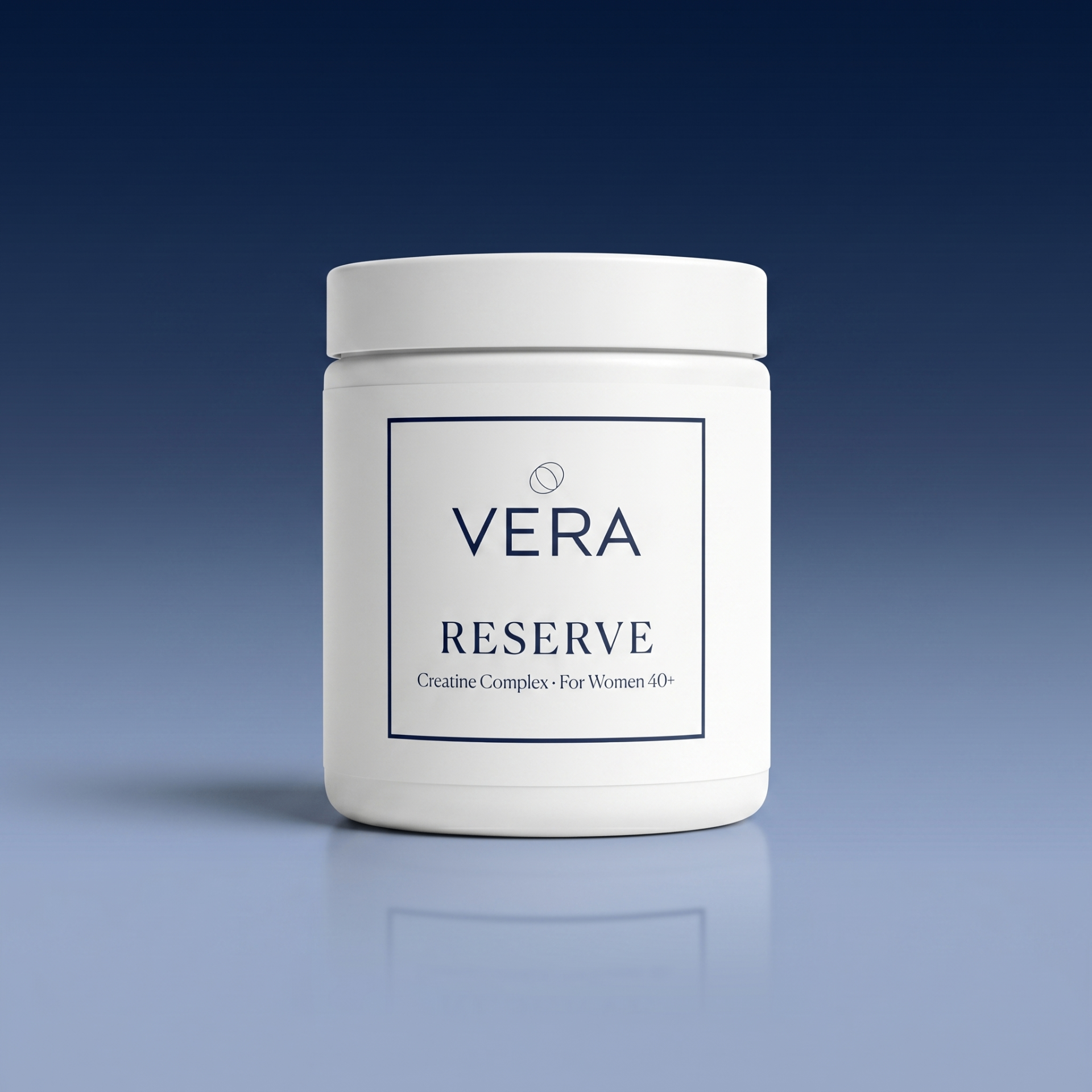
This is the whole reason Vera Reserve exists.
It's a once-daily creatine complex formulated for the female body in midlife — not a scaled-down version of a men's product. Every scoop delivers the full 5,000 mg clinically studied dose of creatine monohydrate (the most-researched, most-validated form), the exact amount the studies actually used — not a sprinkle to make a label look good.
Alongside it: magnesium malate, a highly absorbable form that supports normal muscle function and helps reduce tiredness and fatigue, plus sodium and potassium electrolytes, because estrogen's decline blunts thirst and sodium handling and midlife hydration needs more than plain water. It's finished with a clean, light natural lemon flavor, lightly sweetened with stevia — no added sugar, no artificial colors, no fillers, no proprietary blends. One 10 g scoop in water, once a day. That's the entire ritual.
It's built to refill the reserve. Nothing more, nothing you can't pronounce.
Inside every scoop
- Creatine monohydrate5,000 mg
- Magnesium malateClinical dose
- Sodium & potassiumElectrolytes
- Natural lemon, steviaNo sugar
Why you may have felt nothing from creatine before
If you've tried creatine and quit, this part matters most.
Creatine works by saturation — it has to build up in your system before you feel it. Think of it like refilling a reservoir that's run low: the first cupfuls disappear into the bottom before the level starts to rise. That's why most women feel nothing in week one, start noticing something in week three, and describe the real difference around month two.
The women who "tried creatine and it did nothing" almost always quit in week one — before the reserve ever refilled. The trick isn't a bigger dose. It's the same clinical dose, taken daily, long enough to saturate.
That's exactly why Vera Reserve comes with a 60-day money-back guarantee. Re-saturation takes weeks, so we want you to give it a real 60 days — long enough to actually feel the difference, not just sample it. If it's not for you, we refund you in full.
What women refilling the gap are saying

"I've started and quit so many things. This is the first where, by week three, the afternoon fog just wasn't there. I got through a full workday without the 3pm crash."
"The word-finding came back first. I'd been losing my sentence halfway through and blaming my age. Not anymore."
"First thing I've taken where I feel in control of my day again. No jitters, no crash — just there."
"I walk and do light weights. For two years, effort gave me nothing back. Now the recovery is there and I'm not wrecked the next day."
The questions women ask before they start
- Is creatine safe for my kidneys?
- Creatine is one of the most-studied supplements in existence, with a long safety record in healthy people. As with anything, if you have a kidney condition, check with your doctor first.
- Will it make me bloat or cramp?
- The old bloating reputation came from high "loading" doses. Vera Reserve uses a single clinical daily dose with electrolytes and magnesium malate, formatted to be easy to take daily.
- Can I take it alongside HRT?
- Vera Reserve is non-hormonal and works on a completely different pathway — it refills the fuel, it doesn't replace the hormone. Many women take it alongside whatever else they're doing. Check with your doctor about your specific regimen.
- Do I have to work out for it to do anything?
- No. The clarity and energy support stand on their own. If you also add regular movement — even walking and light resistance — creatine supports muscle strength and tone on top of that.
Refill the reserve estrogen stopped guarding
The fog that flips on like a switch. The words that go missing. The afternoons that flatten you. They're not a character flaw and they're not just "getting older." They're the signature of empty packets — a specific, measurable, refillable deficit.
Planck showed us energy comes in whole units. Your cells prove it every day. And for the first time, there's a product built to refill the one that estrogen quietly stopped guarding.
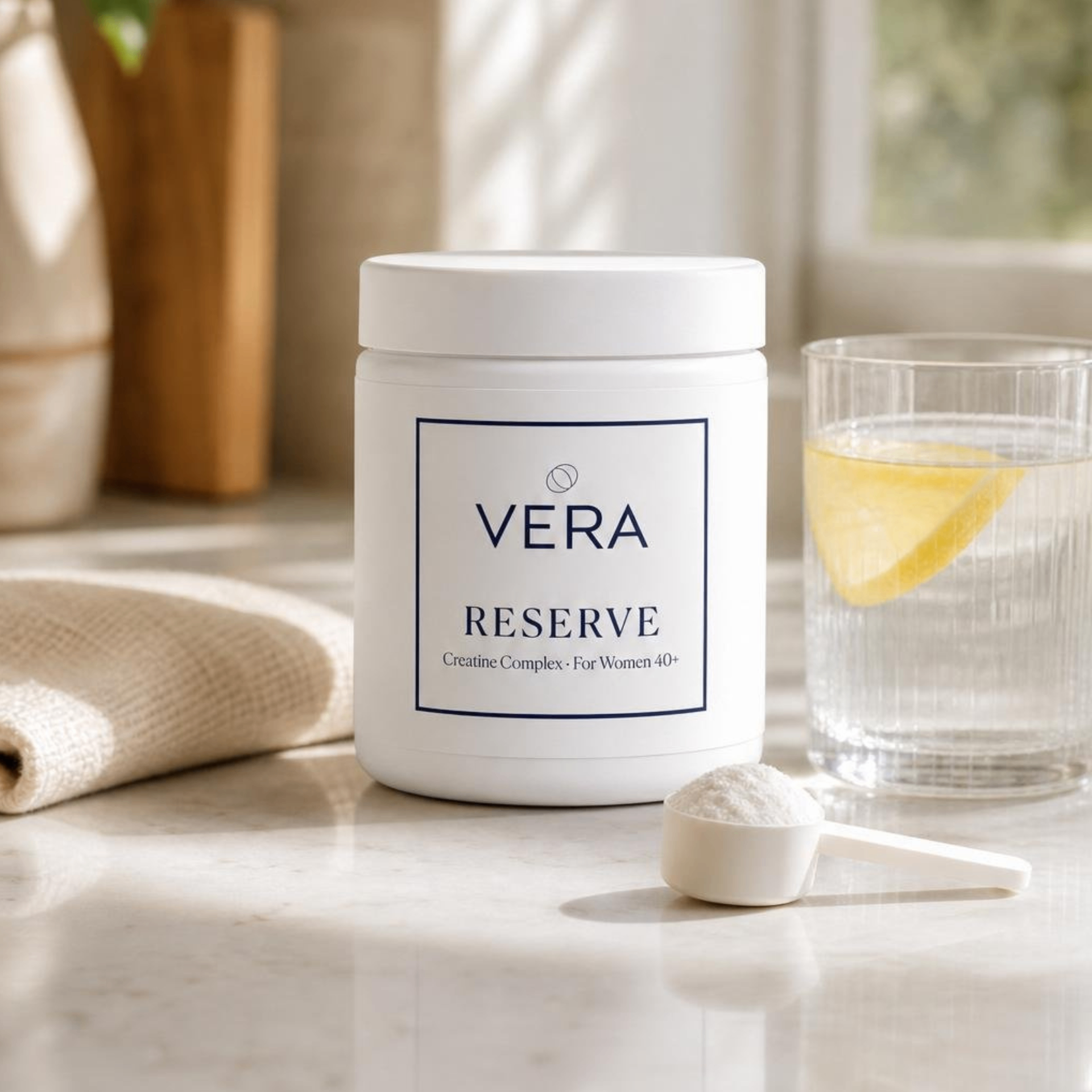
Choose your reserve
- 1 Jar$49.99
- 3 Jars · Best Value$39.99 ea
- 6 Jars · Best Seller$29.99 ea
- Subscribe & Save · up to 60% offfrom $19.99
Free shipping over $69 · 60-day money-back guarantee · Third-party tested · GMP certified · Made in USA
These statements have not been evaluated by the Food and Drug Administration. This product is not intended to diagnose, treat, cure, or prevent any disease. Vera Reserve is a non-hormonal dietary supplement and is not a substitute for hormone therapy or medical care.